
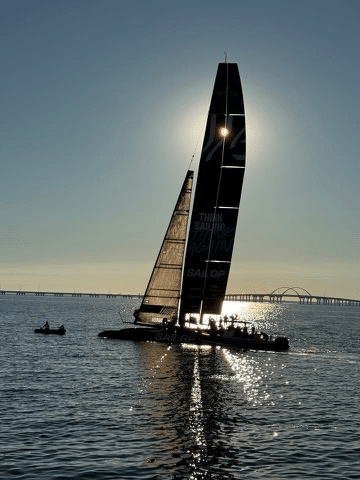
PENSACOLA • SAILGP • PERFORMANCE
Five SailGP teams trained in Pensacola before Dubai. What do the results—and the gaps in the data—tell us?
New Zealand won in Dubai. Australia finished second. Both had trained in Pensacola, which gives those of us following the teams here something to smile about. But how much credit belongs to the time they spent on our bay? To get beyond the podium, we need to look at what each crew came here to practice and what happened next.
What we know so far, as of November 23, 2026: This first look at the November 21–22 Dubai event draws on published results and team accounts, with calculations by FoilForward. We don’t yet have a verified, complete set of start and maneuver data from before and after the camps. So we can compare results, but we can’t say how much Pensacola training caused them to change.
We’re following five teams whose Pensacola visits and training goals appear in the reports linked below: New Zealand’s Black Foils, Australia’s BONDS Flying Roos, Emirates GBR, Denmark’s ROCKWOOL Racing and Germany. There may have been other visitors; this isn’t a complete visitor list. And these five didn’t all get the same experience. They sailed for different amounts of time, in different conditions and with different crew members.
How much time did they spend here? GBR’s October 27 team report describes a week-long camp; MySailing’s November 15 Black Foils recap reports seven days for New Zealand. Germany announced a ten-day camp; Australia reported a week divided between its race and development squads; Sehested reported 14 sailing hours over six days. A week at the base isn’t the same as a week on the water. Some of these reports describe plans, others count days, and one gives actual sailing hours. We don’t have exact arrival and departure dates or hours in each role, so we shouldn’t treat these totals as equivalent.
What changed in Dubai?
To put Dubai in perspective, let’s look at the three events before it: Sassnitz, Valencia and Geneva. The table gives us a sense of each team’s recent form, though the wind and equipment weren’t necessarily comparable. A smaller placing number is better. There’s another wrinkle: the top four places come from the final, while the rest come from qualifying, so an event placing doesn’t describe every team’s racing in quite the same way.
On a narrow screen, swipe the table sideways to see all columns →
| Team | Sassnitz | Valencia | Geneva | Prior average | Dubai | Change |
|---|---|---|---|---|---|---|
| New Zealand | 4 | 11 | 5 | 6.7 | 1 | 5.7 places better |
| Australia | 1 | 2 | 2 | 1.7 | 2 | 0.3 places worse |
| Great Britain | 9 | 6 | 9 | 8.0 | 13 | 5.0 places worse |
| Denmark | 10 | 4 | 3 | 5.7 | 9 | 3.3 places worse |
| Germany | 7 | 8 | 12 | 9.0 | 10 | 1.0 place worse |
Sources: The Foil’s prior event results and Scuttlebutt’s Dubai results. Prior average is the arithmetic mean of the three placings; changes use unrounded means and are displayed to one decimal place. These are descriptive comparisons, not estimates of training benefit.
New Zealand’s win was a substantial improvement over its recent average. Australia remained close to an already exceptional level. Germany improved on Geneva’s 12th but finished below its three-event average. GBR and Denmark also finished below their recent averages. That tells us where the teams finished. It doesn’t tell us whether they crossed the start line better or carried more speed through a gybe.
New Zealand also entered Dubai with a disrupted season and strong venue form: it had missed four events after its Auckland collision, and had won the two preceding Dubai editions, in 2023 and 2024. Getting back into racing and knowing the venue may also have helped. We can’t separate those effects from the camp just by looking at the result. SailGP’s Black Foils recap.
Five teams, different training goals
New Zealand: more sailing time and a deeper squad
Looking ahead to 2027, the Black Foils used Pensacola to develop reserves Jake Pye and Kate Stewart, give the frontline crew more time in the boat and build depth for 2027. Pye practiced wing-trimmer and flight-controller roles; Stewart trained as a strategist. SailGP’s camp report.
In Dubai, they finished 1–5–4–1 in qualifying, then won the final.
That’s a terrific result for the frontline crew. It doesn’t tell us how close the reserves are to being ready to race, though. For that part of the camp’s work, we’d want to hear from the coaches and know how much time each sailor spent practicing a new role.
Australia: prepare for the final and develop the next crew
Australia worked on pre-starts, boat handling and racing scenarios, while dividing its week between the race squad and wider-squad development. Its main competitive target was the Abu Dhabi Grand Final. SailGP’s Australian camp report.
They finished 1–4–3–2 in Dubai qualifying and took second in the final. Remember, their previous three event results were already 1–2–2.
When a team is already finishing first or second, improvement may not show up in its placing. The Roos could be starting more cleanly or losing less speed in maneuvers without moving up the results sheet. We need those details, along with a check on reserve readiness. Abu Dhabi will be especially worth watching because that was the team’s main target.
Great Britain: starts remained a stated problem
Emirates GBR came to Pensacola with a clear priority: improving starts and its starting playbook. The camp also gave sailors practice in different onboard roles. GBR’s training report.
Dubai was a difficult weekend: finishes of 5–6–6–4 in qualifying left GBR 13th overall. In SailGP’s day-one report, Dylan Fletcher said, “personally, I didn’t deliver at the start.” SailGP’s Dubai day-one report. The Foil subsequently reported his concern about coordination in the final 30 seconds before starts. The Foil’s post-event interviews.
Fletcher’s comments tell us more about that training goal than 13th place alone: starts were still troubling him. We can’t put a number on any improvement without comparing all the starts before and after camp. And the work with additional sailors needs to be judged separately from the race crew’s weekend.
Denmark: light-air modes, start timing and future depth
Speaking to The Foil, Nicolai Sehested described work on light-air downwind modes with the H2 sail and timing approaches to starts. He reported 14 sailing hours over six days, including substantial heavy-weather practice and work with additional sailors. The Foil’s interviews with Sehested.
Denmark went on to finish 4–3–5–4 in qualifying and ninth overall. In YACHT’s reporting, Sehested said the Danes were shown an incorrect course display, incurred a boundary penalty and dropped from the front of the fleet to the back. This is the team’s account, not an independently quantified estimate of places lost.
Ninth place gives us no immediate improvement to point to, but it leaves plenty unanswered. Did Denmark get downwind faster, stay on the foils longer or time its starts better in similar conditions? Dubai’s light air tells us little about the heavy-weather work, and the reported display failure makes the result harder to interpret.
Germany: starts, split-fleet execution and role understanding
After Geneva, Germany identified inconsistent starts and preparation for split-fleet race situations as priorities for a planned ten-day Pensacola camp. That was the plan for the camp, rather than a confirmed count of days sailed. YACHT’s post-Geneva report also identifies the ten-day plan and focus on consistent starts. Its Pensacola camp report describes regular role swaps to improve understanding of one another’s jobs, including flight controller James Wierzbowski taking the helm while Julian Hoffmann practiced flight control. German sailing federation report.
In Dubai, the team recorded 3–3–7–5 in qualifying and finished tenth overall. Erik Heil told YACHT that Germany lacked functioning software and start-time information in its first Sunday race, receiving delayed timing from the coach box. With that problem in the mix, a poor start can’t simply be blamed on ineffective training.
Two third-place finishes give Germany something to build on. Were those good starts, or did the crew recover later in the race? We’d need first-mark positions and line-crossing data for every completed race to answer that.
All five teams’ qualifying sequences are from the published Dubai results report.
Another way to read the qualifying results
Season points carry all the earlier racing with them, so they aren’t a clean test of a recent camp. For Dubai qualifying, we can also ask a simple question: what share of the other boats did each team finish ahead of? This accounts for the groups having different numbers of boats. It still only describes finishing places, not starts or maneuvers, and it doesn’t account for how strong the opponents were. Use it within each group, rather than as a ranking across the two.
Percentage of opponents beaten = 100 × (group size − finishing position) ÷ (group size − 1). We calculate it for each qualifying race and average the four races, excluding the event final.
| Team | Group / boats | Average opponents beaten |
|---|---|---|
| New Zealand | A / 7 | 70.8% |
| Germany | A / 7 | 41.7% |
| Great Britain | A / 7 | 29.2% |
| Australia | B / 6 | 70.0% |
| Denmark | B / 6 | 40.0% |
FoilForward calculations from the linked Dubai race results: seven boats in Group A and six in Group B. This is a Dubai benchmark, not a measured improvement. Earlier race sequences are available—for example, Scuttlebutt’s Valencia results—but a consistently calculated race-level baseline across all three earlier events has not yet been assembled and checked. Four completed qualifying races are a small sample. Group A’s second race was restarted after technical problems; only its completed result is counted. YACHT’s day-one report.
What we’d still like to know
- Starting gains: complete first-mark positions, crossing delays, crossing speeds and early-start penalties before and after camp. First-mark position is only a proxy: it includes the opening leg as well as the start.
- Maneuver gains: comparable foiling tack and gybe success rates, speed loss, recovery time and unplanned touchdowns. Broadcast coverage alone does not capture every maneuver.
- Training exposure: actual hours by sailor, role, wind range and equipment. Planned camp dates and days at the venue should not be treated as hours sailed.
- Electronics effects: competitors reported failures involving GPS, start timing and course displays in Dubai. Their accounts are evidence of a confounding factor, not a measurement of its effect on each result. Start analysis and telemetry need checks for those disruptions; the cause of the failures is not established here. Competitor accounts.
- Causation: crews, conditions, opponents and prior ability differ. Teams that did not visit Pensacola cannot automatically be treated as having done no preparation.
What should we watch next?
The next step is to pick a measure that fits each team’s goal before we see its next result. For GBR and Germany, track legal starts, crossing execution and first-mark position. For Denmark, add downwind performance in matched light-air conditions. For Australia, assess pre-start execution and boat handling alongside its Grand Final objective. For New Zealand, record readiness in the reserve roles it actually trained.
Then we can compare each team with its own pre-camp performance. Where conditions are similar, it would also help to see how teams that didn’t attend changed over the same period. Abu Dhabi and later comparable events will give us more to work with, although even a longer run of results won’t isolate the camp’s contribution perfectly.
What Pensacola can reasonably claim
American Magic owns and operates Denmark’s ROCKWOOL Racing, as confirmed in SailGP’s February acquisition announcement. It hosts SailGP’s Pensacola training base at its High Performance Center and serves as the team’s Global Performance Partner, according to its May 2026 announcement. SailGP manages scheduling at the shared facility to ensure fair access, as described in the October 19 opening announcement. That helps explain the connections between the base and the team. It doesn’t, by itself, show that Denmark gained a racing advantage in Dubai.
Pensacola gave these crews time to practice specific skills and bring more sailors along. Dubai gave us mixed results. We can see what the teams worked on, but we can’t yet measure how much that work changed their racing.
For those of us interested in Pensacola’s marine economy, there’s more to watch than the finish line. Teams returning to train need facilities, technical support and local services whether they win or not. To understand what that means for our community, we should track how long teams stay, what they buy locally, how they use the facilities and whether they book another visit. A podium photograph is exciting; those numbers would tell us much more about the business opportunity.
For background on the boats and the local marine opportunity, read The path to SailGP’s foiling cats and explore FoilForward’s Pensacola Marine Vision.
Why we’re following this: FoilForward works to grow Pensacola’s marine business community. That’s why the training base interests us, and why we want to be clear about both the promise and what the evidence can actually support.